Logo specs

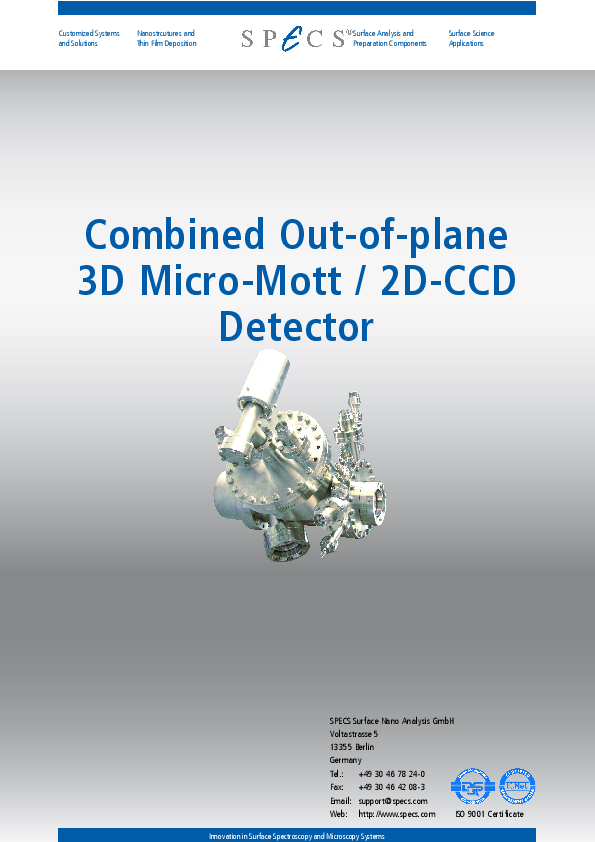
3D-Mott - 2D-CMOS/-CCD Detector

Combined 3D Spin Detector based on the MOTT principle with 2D CMOS detector for high performance ARPES and Spin detection.
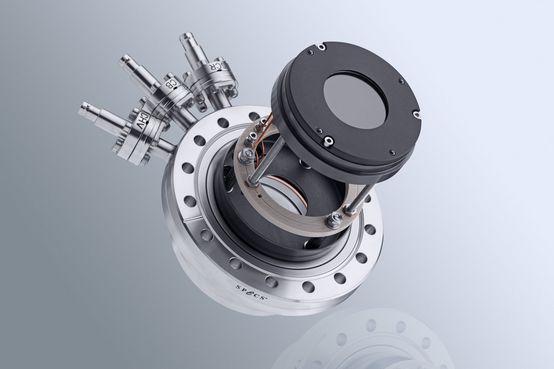
3D Spin detection combined with full scale 2D APRES measurements provide a deep understanding of the electronic structure of spin polarized solids. The combination of the existing high performance 2D detection systems with power spin detectors and optics, allow measurements of the electronic structure on a new level.

The 2D-CMOS/3D Spin MOTT detector uses the MOTT detection scheme for the spin detection. High energy scattering on a thin Tungsten target is used for spin scattering process. This mode runs stable without preparation of the scattering target. In addition, the scattering Scheme allows detection of 4 channels (2 per spin direction) simultaneously, allowing a high perfomance of the spin detection process.

With the patented spin rotator and 90°deflector scheme, all three spin components from the sample can be analyzed. The 90° deflector allows access the one out of plane spin component and the spin rotator switches the detectable in plane component to measure all components in subsequent measurements. The angular range can be refined by using integrated entrance apertures. An additional full scale 2D CMOS detector on the energy dispersive axis is used to acquire APRES data on the same angular region as the spin detector channel.
KEY FEATURES

  • Full 3D Spin Detection
  • MOTT Detection Sheme
  • Patented Spin Rotator
  • Full Size 2D CMOS Detector
  • No Preparation Needed

MADE FOR THESE METHODS

2

RELATED PRODUCTS

56

APPLICATION NOTES

PUBLICATIONS

  1. (2025) Engineering a Spin-Orbit Bandgap in Graphene-Tellurium Heterostructures

    Intensive research has focused on harnessing the potential of graphene for electronic, optoelectronic, and spintronic devices by generating a bandgap at the Dirac point and enhancing spin-orbit interaction. While proximity to heavy p elements is promising, their interaction in graphene heterostructures remains underexplored compared to ferromagnetic, noble, or heavy metals. This study demonstrates the effective intercalation of Te atoms in a graphene/Ir(111) heterostructure. Using low-energy electron diffraction and scanning tunneling microscopy, two distinct structural phases are identified as a function of Te coverage. Angle-resolved photoemission spectroscopy reveals a 240 meV bandgap at the Dirac cone at room temperature, preserving linear dispersion, along with a pronounced n-doping effect confirmed by quasiparticle interference maps. Notably, reducing Te coverage tunes the Dirac point toward the Fermi level while maintaining the bandgap. Spin-resolved measurements uncover a non-planar chiral spin texture with significant splitting in both in-plane and out-of-plane components, as well as evidence of an emerging edge state from scanning tunneling spectroscopy. These findings highlight Te-enhanced intrinsic spin-orbit coupling in graphene, surpassing the extrinsic Rashba effect and promoting a spin-orbit-induced bandgap. This system offers a promising platform for spin-dependent transport phenomena, such as the quantum spin Hall effect.


    Beatriz Muñiz Cano,Fabián Calleja,Daniela Pacilè,Marc G. Cuxart,Michele Pisarra,Antonello Sindona, Fernando Martín,Elena Salagre,Pilar Segovia,Enrique G. Michel, Amadeo. L. Vázquez de Parga, Rodolfo Miranda,Julio Camarero,Manuela Garnica, Miguel
    Advanced Functional Materials
    Read more

SPARE PARTS

2
Product image
Product description
Article No.
 
Channelplates Set - 1 pair MCP 40

Spare channelplate set for all 40 mm CCD detectors

2060009045
Phosphor screen

Spare phosphor screen for all 40 mm CCD detectors. Exchange with channelplates is recommended.
2060008804

DOWNLOADS

2
Close
Your web browser is deprecated
This could effect the presentation and some functions of our website.