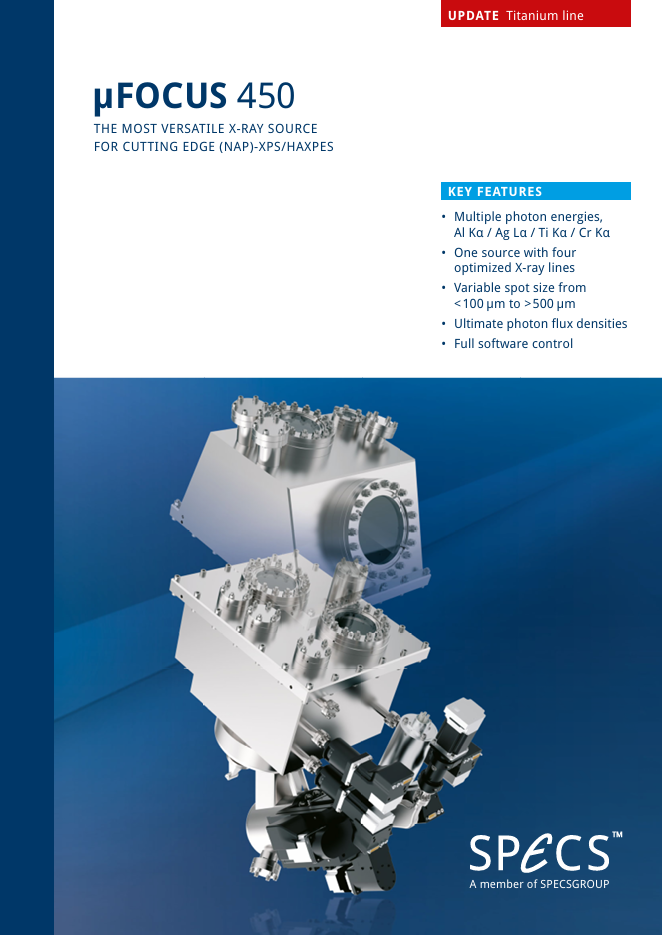
µFOCUS 450
The multi-line small spot monochromator µFOCUS 450 is made for XPS & HAXPES measurements in ultra-high vacuum (UHV) as well as in near ambient pressure (NAP).
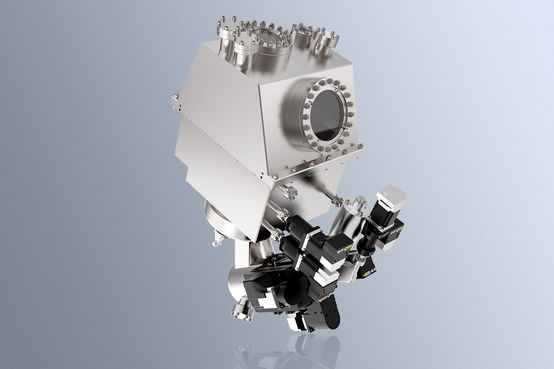
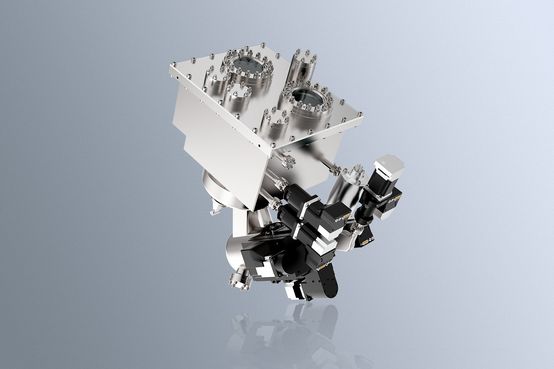
The μFOCUS 450 is a unique small-spot Rowland-geometry X-ray monochromator dedicated to surface analysis and non-destructive depthprofiling by offering variable excitation energies. It provides a fully software-controlled, in-situ selection of up to four monochromated X-ray excitation lines – Al Kα (1487 eV), Ag Lα (2984 eV), Ti Kα (4511 eV) and Cr Kα (5414 eV) – opening the way to advanced XPS/HAXPES experiments under ultra-high vacuum (UHV) as well as in near-ambient pressure (NAP) conditions in a laboratory.
Each X-ray source is individually optimized for peak performance, with precise control of the monochromator position, anode alignment, and the insertion or retraction of individual monochromators.
Traditionally, switching between X-ray lines would require careful manual realignment and setup; here, all adjustments are handled through intuitive software control. Users can switch between X-ray lines instantly during a single experiment, enabling rapid, uninterrupted changes that provide real-time depth information. Experiments can also be run unattended for extended periods – overnight, over weekends, or during the day – with minimal intervention required all while switching between sources.
Source Design
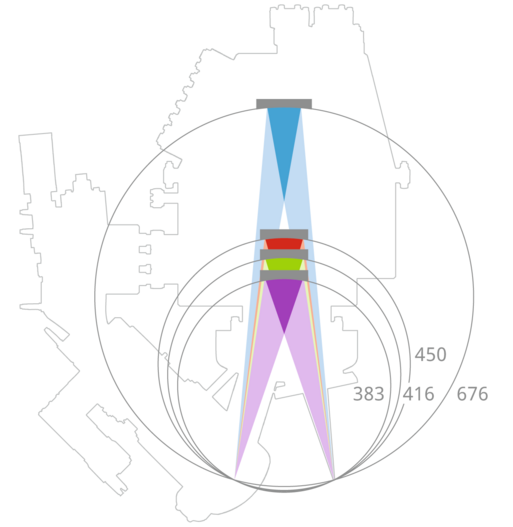
In contrast to traditional source concepts that often derive multiple X-ray energies from a shared crystal, the μFOCUS 450 incorporates dedicated monochromator assemblies for each X-ray line within a single source housing. Each configuration combines an optimized anode and crystal, maximizing photon flux density and spectral performance across the full energy range. The design allows for an upgrade of each X-ray line at any time and also provides specialized NAP extension for seamless operation at elevated pressures up to 50 mbar.
New Titanium X-ray Line
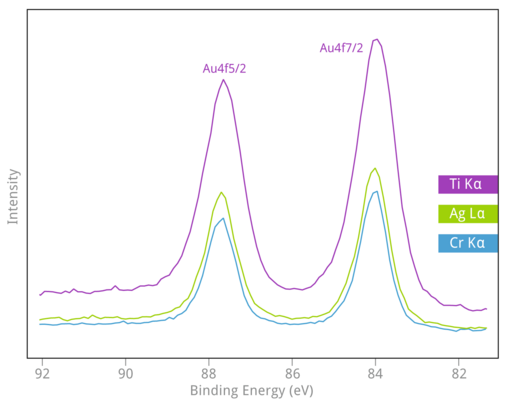
The titanium Kα line, newly integrated into the source design, is unique in the market and closes the energy gap between silver and chromium. It offers substantially higher usable photon flux than Ag and Cr while maintaining high excitation energy, leading to improved count rates and better signal-to-noise in less time for quantitative layer thickness and interface characterization.
(Figure left: HAXPES analysis of Gold using Ti Kα, Ag Lα, and Cr Kα lines)
Laboratory (NAP)-XPS/HAXPES
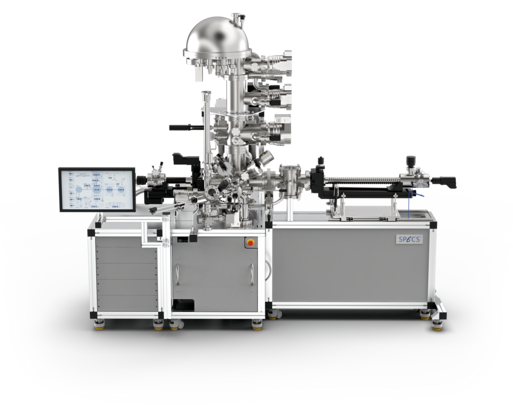
The μFOCUS 450 represents a major advancement for modern XPS/HAXPES measurement systems. Paired with a suitable electron analyzer for UHV or NAP operation, it enables faster, higher-quality, and more versatile analysis. Whether integrated into an optimized ProvenX system, an EnviroMETROS metrology tool, or a fully customized solution, the μFOCUS 450 elevates system capability to a new level.
SPECIFICATIONS
| Maximum Anode Voltage |
|
| Working Conditions | UHV |
| Required Accessories | Closed-Cycle Water Cooling System |
| Monochromated | Yes |
| Anode Materials Available |
|
| Power Supply | COSCON XMS |
| Mounting Flange | DN100 CF |
| Insertion Depth | 170 mm |
| Rowland Circle Diameter |
|
| Spot Size |
|
| Energy Resolution |
|
| Flux (Ph/s) at Maximum Power |
|
| Flux (Ph/s) at Smallest Spot Size |
|