
Bridging the Final Frontier: Achieving 1 bar Ambient-Pressure XPS in a Laboratory System
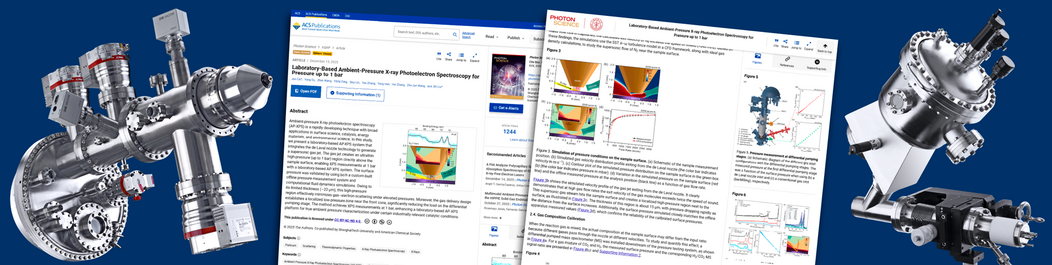
In a paper, researchers from ShanghaiTech University and the American Chemical Society present a groundbreaking laboratory-based ambient-pressure XPS system capable of performing measurements at pressures of up to 1 bar. Read the original paper here: doi.org/10.1021/photonsci.5c00030.
For decades, the "pressure gap" has remained a fundamental challenge in surface science. While X-ray Photoelectron Spectroscopy (XPS) is the gold standard for probing chemical states, its traditional requirement for ultra-high vacuum (UHV) has limited our ability to observe materials under realistic, industrially relevant conditions. A groundbreaking study now presents a laboratory-based AP-XPS system capable of performing measurements at a true ambient pressure of 1 bar.
The Innovation: Supersonic Gas Jets and the de Laval Nozzle
The core of this advancement is the integration of a de Laval nozzle into the gas inlet system. Unlike conventional backfilling methods that establish a uniform pressure throughout the chamber, this system utilizes a supersonic gas jet to create a localized high-pressure region approximately 15–20 μm thin directly above the sample surface.
This design offers two critical technical advantages
- Minimized Photoelectron Scattering
The ultrathin nature of the high-pressure zone ensures that the effective path length for photoelectrons is drastically reduced, allowing for detectable signals even at 1 bar. - The Bernoulli Effect
The high-velocity gas stream creates a localized low-pressure zone near the analyzer's front cone. This significantly reduces the load on the differential pumping stages, maintaining the vacuum required for the PHOIBOS 150 NAP analyzer to operate safely while the sample experiences 1 bar.
Experimental Validation and Performance
The system was validated using a Pt(110) surface exposed to nitrogen (N2). The researchers successfully recorded Pt 4f spectra at 1 bar, observing a characteristic energy-loss peak at 13.8 eV above the main line—a direct result of inelastic scattering within the high-pressure gas layer. Furthermore, the system demonstrated remarkable mechanical stability, with signals remaining consistent over extended measurement periods and showing excellent reproducibility during nozzle repositioning.
Technical Specifications
- Analyzer
SPECS PHOIBOS 150 NAP with a differentially pumped electrostatic pre-lens. - X-ray Source
SPECS μ-FOCUS 600, a monochromatized Al Kα, providing a highly focused 200 μm beam. - Thermal Control
Integrated laser heating capable of ramping temperatures from 300 to 1200 K.
This development marks a significant shift in surface characterization, moving beyond the constraints of synchrotrons and bringing true operando studies—ranging from nanoparticle powders to solid oxide electrochemical cells—directly into the laboratory.
The results speak for themselves: achieving stable, reproducible XPS data at 1 bar with the PHOIBOS 150 NAP and µ-FOCUS 600 is a remarkable testament to the robustness of SPECS instrumentation. For researchers looking to build on these pioneering findings, SPECSGROUP continues to advance the state of the art: the AEOLOS 150 analyzer and the µ-FOCUS 450 X-ray source bring enhanced performance and flexibility to ambient-pressure XPS setups—ready to push the boundaries even further.