
A New NAP-XPS/HAXPES System for iNANO at Aarhus University
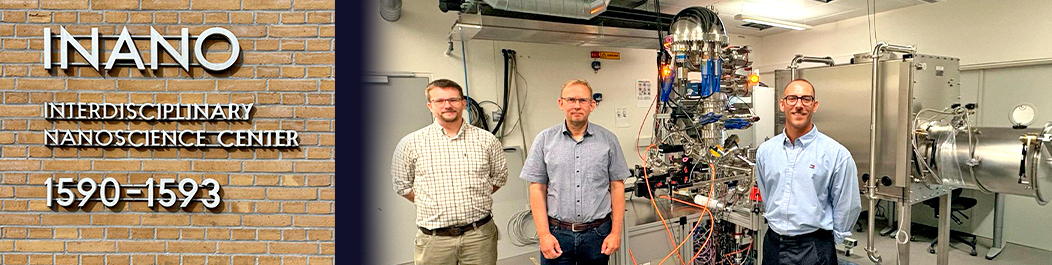
We were happy to see that the system had been up and running since the day after Barbara left, and that we have been using it every day since.
Dr. Marcel Ceccato summarized
… editor's note: "Barbara" refers to Dr. Barbara Osinger from the SPECSGROUP project team, who was responsible for the installation and commissioning of the system.
The Interdisciplinary Nanoscience Center (iNANO) at Aarhus University has expanded its surface analysis capabilities with a new NAP-XPS/HAXPES platform. Officially handed over on April 24, 2026, the system has been in daily operation ever since. It is now used by the research groups of Professor Jeppe Lauritsen and Dr. Marcel Ceccato to investigate topics ranging from catalysis and corrosion to materials chemistry—research areas that perfectly reflect iNANO's interdisciplinary approach of bringing together chemists, physicists, biologists, and engineers under one roof. The system was purchased with funding from the Novo Nordisk Foundation and is part of the research infrastructure program that Professor Lauritsen had received in 2023.
The system combines Near-Ambient Pressure X-ray Photoelectron Spectroscopy (NAP-XPS) with Hard X-ray Photoelectron Spectroscopy (HAXPES), enabling researchers to investigate surfaces and interfaces under conditions that are much closer to real operating environments than conventional ultra-high vacuum XPS. This is particularly valuable for studying processes that only occur in the presence of gases or under realistic reaction conditions.
At the heart of the platform is a PHOIBOS 150 NAP electron analyzer with an AD-CMOS detector, complemented by a µFOCUS 450 X-ray source equipped with both Al and Cr anodes to cover conventional and hard X-ray energy ranges. A four-axis manipulator with an integrated electrochemical cell (EC-cell) further extends the system's capabilities by enabling electrochemical experiments directly inside the analysis chamber.
Several features make the platform especially versatile. A 975 nm laser sample heater with up to 170 W output allows precise temperature control while minimizing heat load on the surrounding chamber—ideal for in situ and operando studies at elevated temperatures. In addition, a vacuum suitcase enables the transfer of air-sensitive samples from preparation to analysis without atmospheric exposure, preserving delicate sample surfaces throughout the workflow.
In early June, our colleague Dr. Simone Creci visited iNANO together with Dr. Douglas Crackett from Nordyx Scientific, SPECSGROUP's sales and support partner for the Nordic countries. The visit was part of our ongoing efforts to strengthen our collaboration with Nordyx, further expand our presence in the Nordic research community, and exchange first-hand experiences with users of the new platform. It was also an excellent opportunity to discuss the researchers' first months with the system and to hear how it has become an integral part of their daily work.
It is always rewarding to see a new instrument quickly become part of a research group's daily routine. We are delighted that the system is already contributing to cutting-edge research at iNANO and look forward to following the exciting scientific results it will enable in the years to come.