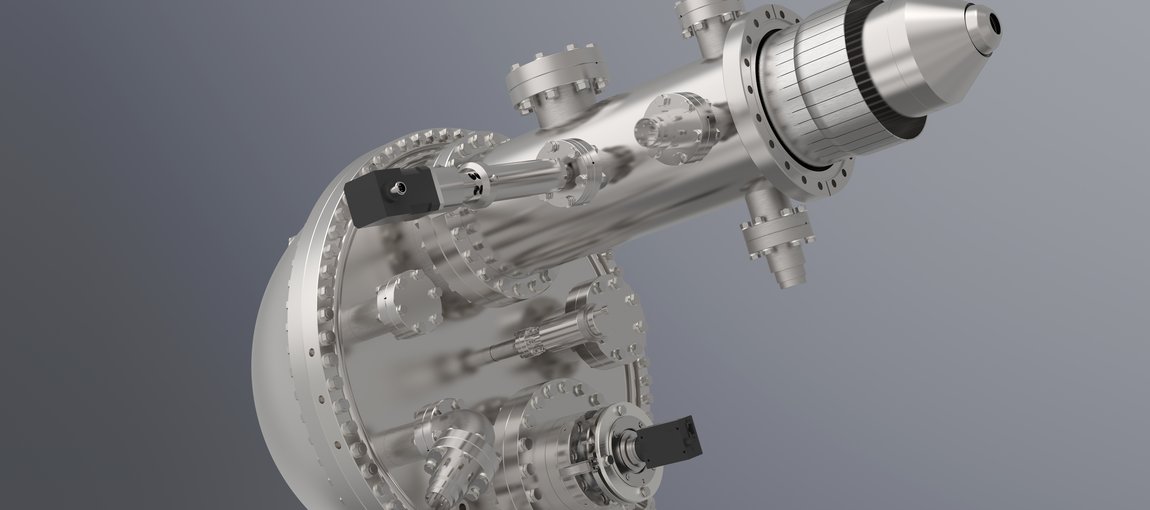
Angle-resolved photoemission spectroscopy (ARPES) provides a direct access to the electronic band structure of solid and molecular systems. The momentum range accessible by this technique depends directly on the photon energy used, and low-photon-energy sources are insufficient to photoemit electrons over the full Brillouin zone of most quantum materials. In addition, while electrons are emitted over a 2<nobr style="border-width:0px;line-height:normal;margin:0px;max-height:none;max-width:none;min-height:0px;min-width:0px;padding:0px;text-decoration:none;transition:none;vertical-align:0px;white-space:nowrap !important;"> </nobr> solid angle, conventional hemispherical analyzers only collect a small subset of those electrons. A previous work [RSI 92, 123907 (2021)] demonstrated that electrons emitted over a larger field-of-view can be acquired in one fixed configuration by accelerating them towards the analyzer with a bias voltage. Here, we extend this work by leveraging the deflector technology of novel ARPES hemispherical analyzers. We demonstrate the ability to detect all <nobr style="border-width:0px;line-height:normal;margin:0px;max-height:none;max-width:none;min-height:0px;min-width:0px;padding:0px;text-decoration:none;transition:none;vertical-align:0px;white-space:nowrap !important;">
 </nobr> photoemitted electrons in a fixed configuration for various materials such as gold, cuprates and transition-metal dichalcogenides. This approach is especially advantageous for time-resolved ARPES, as electron dynamics over a large momentum range can be accessed with identical measurement conditions.
Nicolas Gauthier, Benson Kwaku Frimpong, Dario Armanno, Akib Jabed, Francesco Goto, Vicky Hasse, Claudia Felser, Genda Gu, Heide Ibrahim, Francois Légaré, Fabio Boschini
Cornell University-Condensed Matter-Materials Science