
Nanonis Tramea
The new approach to transport measurements on nanodevices
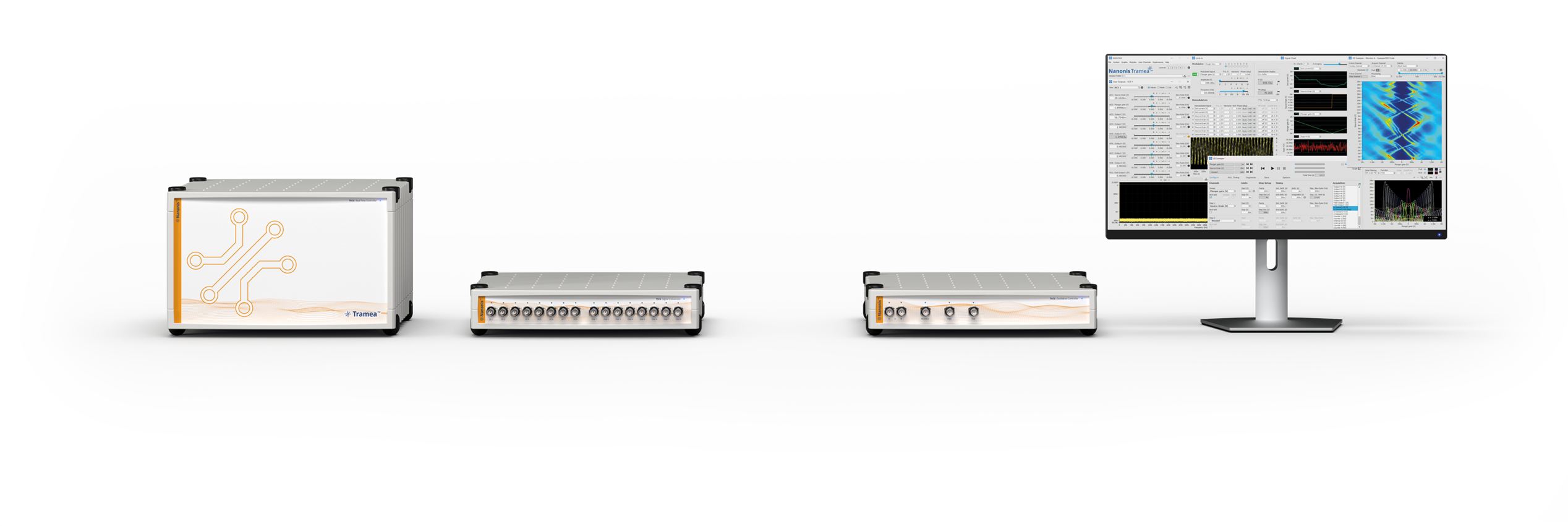
Nanonis Tramea is the new multi-channel, distributed and synchronous system designed for transport measurements at low temperatures.
A modular concept for transport measurements
Nanonis Tramea was designed as a flexible solution for distributed measurements and optimized for low HF signature and small signals. Its architecture enables a placement of the signal interfaces at a significant distance from the central processing core.
Key Features
- Up to 128 input and output channels
- All channels are synchronous and accessible in real-time
- Designed for DC and AC measurements
- Replaces up to 16 lock-ins at up to 25 MHz
- Up to 26-bit input resolution for digitizing the
smallest signals - Output noise below 4 nV/√Hz
- Up to 24-bit output resolution
Real-time Control
A key benefit of the real-time controller TRC6 is the direct access and visualization of all raw signals. This is available in the system, eliminating the need for pre-processing and data-rate reduction in add-on instruments.
To ensure a low-latency and reliable data transfer at a significantly higher speed than before, a revolutionary data transfer architecture was designed. It supports a 7× higher data transfer rate, sampling rates up to 200 MS/s, synchronous data input and output over all interfaces in the system, and plug & play operation.
Designed for distributed measurements and optimized for low HF signature and small signals, the architecture enables a placement of the signal interfaces at a significant distance from the central processing core. The TRC6 uses galvanically isolated optical fibers. For complex measurements, a single system can handle over 128 outputs or inputs and over 250 monitoring signals, with over 200 signals simultaneously available in the user interface. To handle this enormous amount of data, the TRC6 offers increased processing power with a larger FPGA, a more powerful CPU, and faster storage.
Signal Conversion
The signal converter TSC6 redefines the meaning of signal interface, offering state-of-the-art performance for quantum transport measurements in any experimental situation.
The 24-bit 2 MS/s ADCs paired with a low-noise, low-drift input stage with variable gain and 200 kHz bandwidth, offer noise as low as 7 nV/sqrt(Hz) and effective resolutions of up to 25 bits, with oversampling being effective down to 1 Hz. A high-impedance input buffer with input bias current below 2 pA, true-differential inputs, selectabe AC-coupling, and flexible GND schemes ensure optimal operation with any sample and electrical configuration.
The 31-bit DAC architecture delivers incredibly clean signals down to smallest amplitudes, with effective resolutions above 24 bit. Output spectral density noise is as low as 10 nV/sqrt(Hz) (±10 V range) or less than 3.5 nV/sqrt(Hz) (±2.5 V range). Output current and voltage are constantly monitored, which allow leakage current detection, and all outputs can act as regulated current sources with maximum currents up to 25 mA. 250 kHz bandwidth and advanced multifrequency functionality allow the TSC6 to replace up to 8 lock-in amplifiers.
Signal Generation
A signal generator leaving nothing to be desired: The TOC6 is a signal generator and digitizer offering bandwidths in excess of 25 MHz with exceptional signal performance down to DC and unique signal parameters. On top of userselectable output amplitude ranges, the TOC6 offers variable filters, which reduce high-frequency noise above the required bandwidth. For low-capacitance loads, the complete output stage can be bypassed, reducing noise levels to less that 5 nV/sqrt(Hz).
The fully differential input stage can be easily adapted to the source impedance, offering userselectable 50 Ohm / 100 MOhm / high impedance settings. A low-noise mode reduces noise to below 4 nV/sqrt(Hz), while a low-capacitance mode lowers input bias current and input capacitance. These features, make the TOC6 a unique digitizer for high-impedance samples, operating from DC with a low 1/f corner up to 25 MHz with excellent dynamic performance. A monitor output adds the functionality of a lownoise, high input impedance, 25 MHz bandwidth differential voltage preamplifier.
Software
The Nanonis Tramea™ software provides a superior integrated framework with impressive embedded functionality. Yet, it is easily expandable for customized experiments using either the existing add-on modules or user-programmed functions.
Based on more than 30 man-years of development and with an excellent track record for reliability, the Tramea™ software can significantly increase day-to-day productivity and efficiency.
- Fully asynchronous multi-tasking user interface
- Software instruments instead of hardware boxes for more performance, flexibility and upgradeability
- Very high speed data generation and acquisition
- Oscilloscopes, spectrum analyzers, data loggers, charts and graphs
- Easy customization through various programming options
For more features and details, please visit the dedicated Nanonis Tramea™ software page
Explore the Nanonis Tramea software
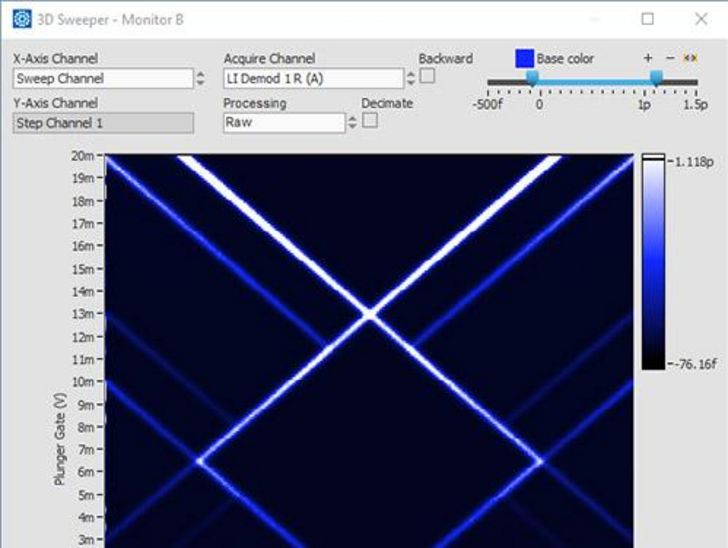
The quantum dot simulator lets you use the complete Nanonis Tramea™ measurement system as if it were connected to a real quantum dot. It includes the full feature set of the software.
- Learn the operation of the software by setting up a stability diagram measurement
- Test the functionality of various software modules including Lock-ins, graphs and sweepers
- Verify the correct functioning of measurement routines written in the Programming Interface, the scripting module or the TCP interface
Register and download our free quantum dot simulator using the link provided below
Quantum Dot Simulator V5e
- The Nanonis V5e software only runs on 64bit Windows operating systems.
- The Nanonis V5e Simulator download link will download a zip file which contains the Nanonis V5e Simulator installer and the Nanonis V5e Runtime Environment. The Nanonis V5e Runtime Environment needs to be installed before running the Nanonis V5e software.
The Nanonis V5e Runtime Environment contains the NI LabVIEW 2019 Runtime Engine, the NI System Configuration Runtime and NI MAX, which are needed to run Nanonis V5e software. The Nanonis V5e Runtime Environment only needs to be installed once, before installing and running the first time Nanonis Software.
Please let us know if you encounter any problems with the installation (contact support@specs-zurich.com).
Quantum Dot Simulator V5
The Nanonis QD Simulator V5 is a 32bit application for the Windows operating system and will not receive further updates.