
Application special: Operando investigations
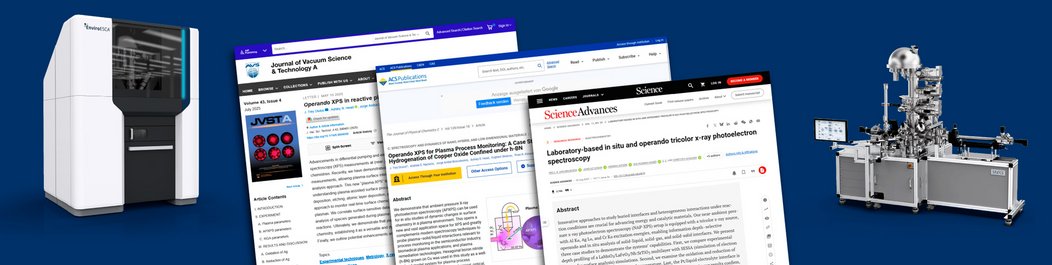
There is a clear gap between laboratory conditions and real-world performance. This happens when ideal testing conditions are assumed: perfectly clean surfaces, defect-free samples, pure reagents, and controlled atmospheres.
Therefore, maybe we should start analyzing systems in real world settings instead! That's called operando studies. It means that the measurement will happen under "operating" conditions, i.e. in an environment that mimics the one in which the system would function. Be it a solvent choice, a specific setting for pressure, temperature, the humidity in the air, or even the presence of contaminants. The difficulty here is to maintain these realistic conditions while still reaching high surface sensitivity and analytical precision.
We have embraced this idea at SPECSGROUP by using differentially pumped lens system in our x-ray photoelectron spectroscopy (XPS) setups. This means that the sample can be in different atmospheres while the analyzer and detector remains in vacuum. It is possible to study reactions from 10°C up to 1000°C, electrochemical processes at electrode interfaces, or even surface chemistry under near-ambient pressures (up to 50 mbar). Let's look at three different ways researchers use near ambient pressure XPS (NAP-XPS) systems like the ProvenX-NAP, FlexPS-NAP, or EnviroESCA for operando studies.
Plasma-induced silver redox chemistry
A. Kolmakov and his team studied the oxidation and reduction of silver under different plasma conditions. They found that by changing the atmosphere in the sample environment, they could observe either the oxidized (air plasma) or reduced (hydrogen plasma) silver state. This is important to identify reaction intermediates in semiconductor nanomanufacturing steps for example.
Read the paper here: doi.org/10.1116/6.0004569
Hexagonal boron nitride and copper interface
The same group continued their work by investigating the stability and surface chemistry of hexagonal boron nitride (h-BN), an important material for advanced electronics. This material is layered onto a copper (Cu) substrate and they focused on this h-BN/Cu interface. They found that Cu oxide layers could form without damaging the top h-BN layer during plasma exposure. This gives insights into short-lived and/or fast-desorbing/diffusing reaction intermediates.
Read the paper here: doi.org/10.1021/acs.jpcc.4c00253
Platinum (Pt) electrochemistry
C. Bäumer and his group looked into the Pt/electrolyte interface. Using a specialized electrochemistry cell, they immersed their Pt electrode in the electrolyte to analyze the interface. They were able to monitor the oxidation and reduction of the Pt depending on the voltage they applied to the electrode. They gathered information on material changes as a function of reaction conditions, which gives crucial insights into understanding catalyst degradation in fuel cells and electrolyzers.
Read the paper here: doi.org/10.1126/sciadv.adw6673
These three examples showcase how operando studies across various temperatures, pressures, and atmospheres can advance our understanding of real-life reactions.
How do you use your NAP-XPS system? How could operando studies push your research forward?