
Nanonis Mimea 6th Generation
The new measurement and control system
The sixth-generation Nanonis Mimea SPM control system represents a new benchmark for scanning probe microscopy, built upon a legacy of over 20 years of intensive research and development and the experience gained from over 1600 systems delivered to the global research community.
A quantum leap for advanced experiments
For more than a decade, the fifth generation Nanonis Mimea SPM control system has been the primary choice for the world’s most demanding SPM experiments, serving as the technical foundation for countless scientific breakthroughs and high-impact publications.
Following our core philosophy that the measurement instruments should never be the limiting factor in a scientific experiment, the system has undergone continuous product development driven directly by the needs of the SPM community.
By combining advanced technology and community-driven development, the Nanonis Mimea SPM control system continues to be a major contributor to global scientific excellence.
Key Features
- Advanced high-speed data processing architecture
- A new standard in signal quality for data acquisition and signal generation
- Unparalleled flexibility in signal modulation and mixing
- Optimal I/O placement capability via galvanically isolated optical interconnects
- Ready and open for AI integration
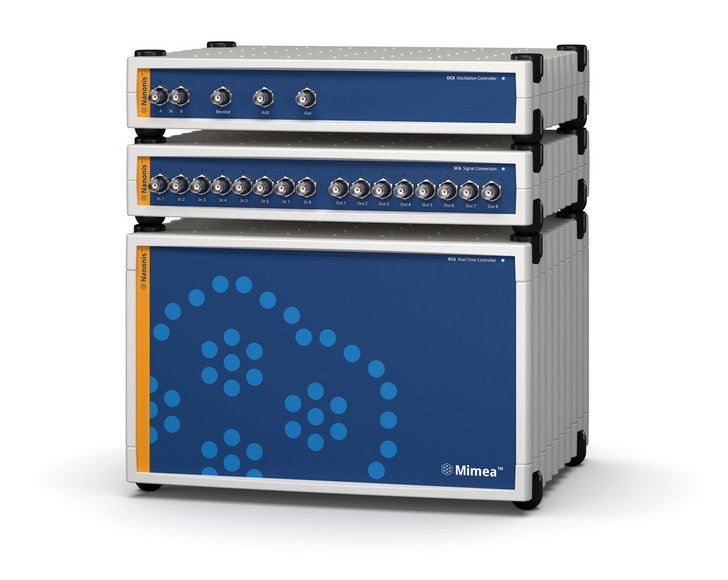
RC6 Real-time Controller
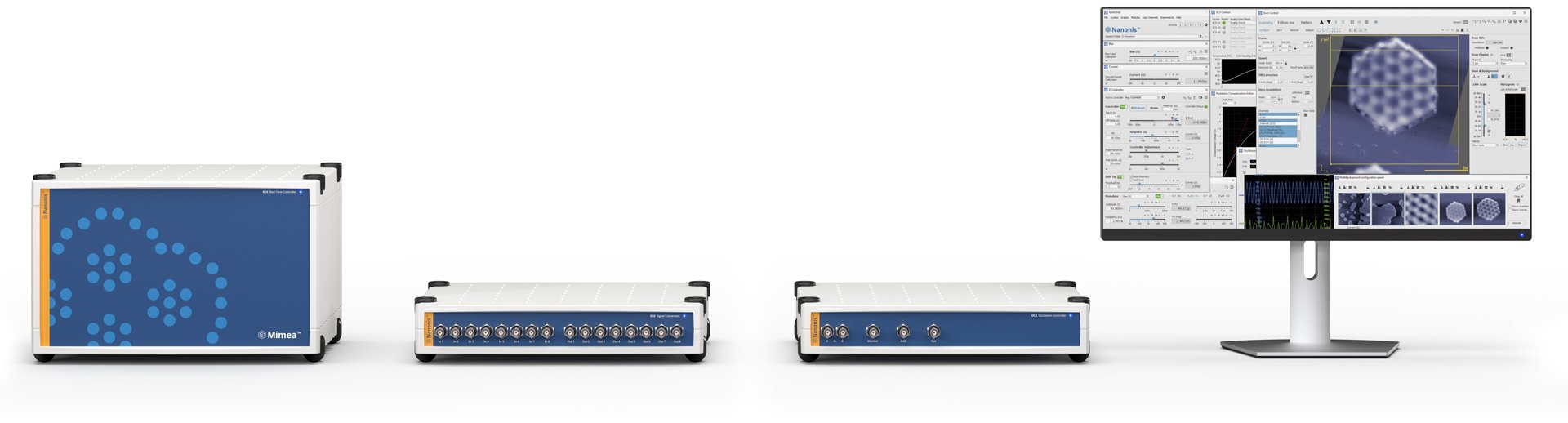
A key benefit of the Nanonis high-speed modular architecture is the direct access and visualization of all raw signals available in the system, eliminating the need for pre-processing and data-rate reduction in add-on instruments. To ensure a low-latency and reliable data transfer at a significantly higher speed than before, a revolutionary data transfer architecture had to be designed. It supports a 7 × higher data transfer rate, sampling rates up to 200 MS/s, synchronous data input and output over all interfaces in the system, and plug&play operation. Designed for distributed measurements and optimized for low HF signature and small signals, the architecture enables a placement of the signal interfaces at a significant distance from the central processing core, the RC6, using galvanically isolated optical fibers. For complex measurements, a single system can handle over 128 outputs or inputs and over 250 monitoring signals, with over 200 signals simultaneously available in the user interface. To handle this enormous amount of data, the RC6 offers increased processing power with a larger FPGA, a more powerful CPU and faster storage.
SC6 Signal Conversion
The SC6 redefines the meaning of signal interface, offering state of the art performance in any experimental situation. The 24-bit 2 MS/s ADCs paired with a low-noise, low-drift input stage with variable gain and 200 kHz bandwidth, offer a 3 × reduction in broadband noise and a 8 × higher effective resolution compared to the previous generation, with oversampling is effective down to 1 Hz. A high-impedance input buffer, true-differential inputs and flexible GND schemes ensure optimal operation with any sample and electrical configuration, while selectable AC-coupling with high gain allows the detection of smallest modulations. The 31-bit DAC architecture delivers incredibly clean signals down to smallest amplitudes eliminating the need for external adders. Variable filters offer a 6 × higher bandwidth and an optimized impulse response for stable feedback. Output noise is twice as low, or even 6 × lower in the ±2.5 V output range, with the improvement carrying over to frequencies below 0.1 Hz. Output current and voltage are constantly monitored, and all outputs can act as regulated current sources with maximum currents up to 25 mA.
OC6 Oscillation Controller
The OC6 is a state-of-the-art signal generator with 5 × the bandwidth compared to the OC4, capable of generating small amplitude signals up to 100 MHz. The redesigned output signal path offers improved linearity, signal purity, and fully digital amplitude control. With user-selectable ranges and filters to reduce broadband noise and optimize signal quality for the application, it offers uncompromised performance also for signals down to DC. The high-current output stage can be bypassed for applications not requiring large driving currents, lowering noise to less than 5 nV/sqrt(Hz). The OC6 is also a sophisticated digitizer, with a DC-coupled high-impedance, fully differential input stage, able to handle signals from DC to 25 MHz or even 100 MHz with highest accuracy. Great care has been given to avoid any interference with even the smallest input signals, resulting in 5 × less noise than the predecessor, a significantly lower 1/f corner frequency and lower distortion. The OC6 provides researchers with a unique, all-in-one tool designed to meet the most demanding requirements in AFM measurements, but able to go significantly beyond those.
Software and add-on modules
The Nanonis V6 software is both familiar and significantly more powerful. It builds onto the proven and reliable V5e software, but supports all the new hardware functionality, including the extensive monitoring and safety features and the over 200 signals accessible in real-time. It offers an unparalleled flexibility in signal modulation and mixing, and twice the number of frequency generators and demodulators. It integrates specialized tools derived from the Nanonis Tramea quantum transport measurement platform. Together with embedded control of external instruments like magnet and temperature controllers or RF generators, such modules make combined SPM and transport measurements much more manageable. The Programming Interface, a game-changing tool for researchers for over two decades, now runs on a generic framework with dedicated Python and LabVIEW interfaces for immediate productivity, and is ready for any advances in machine-learning based routines. The V6 software combines reliability with modular features and continuous development.